More information, more content, more background:
the German website of EUROPEAN HOSPITAL is now available.
Please indicate your prefered language:

Certainly, you may switch languages at any time during your visit to our website. Enjoy!
Your EUROPEAN HOSPITAL team
Cardiovascular ultrasound
Developed in partnership with international cardiologists, Medison reports that its EKO7 Cardiovascular Ultrasound system is a dedicated Cardiovascular Ultrasound system ‘…with 2-D Image Quality that you would expect from a premium class ultrasound system. As a matter of fact, the same applies to the colour Doppler, Pulsed Wave Doppler and CWD. So the EKO7 has excellent image quality, a dedicated cardiac measurement package, good ergonomics, on board reporting system.’
Reuse of single-use devices - Safety and Ethics not so clear
Eucomed, the European Medical Technology Industry association, welcomes the European Commission's (EC) report on the reprocessing of medical devices. While remaining typically neutral in terms of action at this stage of the debate, the EC report confirmed that even with all the evidence and scientific opinion available "...it is not possible to quantify the risk associated with the use of reprocessed single use medical device."
The Hospital Management Symposium 2010
Radiology and Management
Hospitals and Cost Management
Cost Management in Radiology
Radiology and Staff Managment
Picking up the pace
After years of go-slow adoption and cautious optimism, European cardiologists are now embracing remote monitoring of cardiac electrophysiology devices. ‘We are at the dawn of a new era,’ concluded Dr Philippe Ritter, Chairman of the Cardiostim 2010 congress, after reviewing findings of studies that delivered unequivocal evidence that remote monitoring is not only a safe alternative to clinic visits but also highly effective for the detection of cardiac events.
Aortic valve replacement in the third dimension
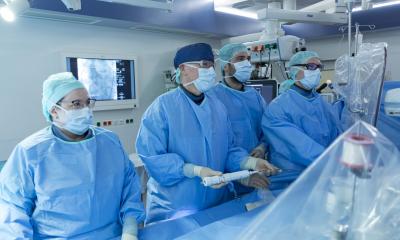
No white lab coats anywhere; instead men in hard hats, equipped with hammers and drills. The Düsseldorf University Hospital’s Cardiology Pneumology and Angiology Clinic is a construction site, but once the workmen have packed up their tools and removed the scaffolding the view to the human heart will be unobstructed and clearer than ever before. Here, innovative patient care and a highly ambitious research project are in the making. Buzz word: Hybrid.
Arteries seen in a new light
New imaging technologies are opening a new chapter in interventional cardiology by offering something this widely practiced procedure has been missing -- vivid clinical evidence to assess effectiveness. Interventional cardiology has moved rapidly from opening blocked arteries by crushing plaque with inflatable balloons to reinforcing the walls of the re-opened arteries with flexible metal stents and then coating the stents with therapeutics to prevent arteries from re-closure.
Multi-modality imaging in coronary artery disease
The focus on Coronary artery disease – from genes to outcomes at ESC 2010 underlines the importance of CAD diagnosis on the scientific agenda. During the session ‘Multi modality imaging to detect coronary artery disease’, chaired by Professor JJ Bax, of the Cardiology Department at Leiden University Medical Centre, the Netherlands, experts will discuss, for example, the advantages of the four most important diagnostic tools and how to use them in daily routine.
Image-Arena analysis and quantification tool for multimodal 2D/3D/4D data
Agfa HealthCare, a leading provider of diagnostic imaging and healthcare IT solutions, announces today that it has signed an agreement with TomTec, active in the sector of echocardiography image analysis, reporting and data management, for the integration of its Image-Arena solution into the company's IMPAX Cardiovascular Picture Archiving and Communication System (PACS). TomTec offers a wide range of 2D and 3D/4D technologies for visualization, analysis, reporting and archiving of echocardiography imaging data.
Toshiba makes cardiac CT safer
To make today’s cardiac CT examinations even safer, Toshiba introduces new, revolutionary “Adaptive Iterative Dose Reduction (AIDR)” technology that lowers the radiation dose to the patient by up to 75% compared to conventional scanners.
Stiff heart - The ‘stepchild’ of cardiology
Patients with heart failure with normal ejection fraction (HFNEF) also referred to as ‘stiff heart’, show a normal ejection fraction and severe diastolic dysfunction. President of the Austrian Society of Cardiology, Professor Irene Lang warns: ‘It is particularly concerning that stiff heart is a little known and insufficiently researched cardiac condition -- a stepchild in research, diagnostics and therapy alike.'
Digital diagnostics in the catheter lab
The VISUS system integrates cardiology modalities from all major manufacturers. Due to the company’s long experience with the communication standard DICOM, which is the corner stone of the integration of images in the PACS, images which are not available in DICOM format are digitalised with the help of a frame grabber, basically an analogue-digital converter.
Cardiometabolic risk assessment
The identification of cardiometabolic risk is one of the most frequently performed standard examinations, which many European health insurers even require for patients of a certain age. Up to now, physicians had to calculate the value manually on the basis of certain parameters – a time-consuming task. seca, which specialises in medical scales, now offers 360° wireless, which not only measures the required parameters but also transfers the data to analysis software.
Meiko Innovation:Top Cut B
Avoiding and reducing waste in the clinical environment not only has highly scalable effects in economic terms, but also marks a key milestone on the path towards a ‘green hospital’. The latest innovation from the company MEIKO makes a major contribution towards reducing waste while simultaneously making nursing staff’s work both safer and easier.
The Heinz Nixdorf Recall Study
Initiated in 1999, the Heinz Nixdorf Recall Study involved 4,814 European participants. The results proved, for the first time, the connection between coronary calcifications and the risk of heart attack, according to scientists at the University Hospital in Essen. The finding by no means exhausted the potential inherent in the surveys. Subsidised until 2013, researchers are examining coronary calcifications in detail as well as exploring other issues.
Heart in hand
Surgeon Alain Carpentier is ready to remove a patient’s heart and replace it with a mechanical device he spent 15 years developing. By 2013 the procedure will be performed on 50 European patients as part of a clinical trial to win CE approval for the world’s first fully implantable artificial heart.
New stents for the future
Drug-eluting stents to treat narrowed coronary vessels met with sensational success, and then things became rather quiet. Now, two new developments from Cordis and Biotronik are being tested at Essen University Hospital, Germany. We asked Professor Holger Eggebrecht, head of the hospital’s cardiac catheter lab, why these new models look important.
New perspectives in coronary plaque imaging using dual source CT
Ongoing technical developments in computed tomography (CT) such as dual source CT have established coronary CT angiography (cCTA) as a robust non-invasive imaging test for the assessment of coronary artery disease. The most important advantage of cCTA over conventional catheter-based coronary angiography is that not only the coronary lumen but also the entire coronary artery wall is visualized allowing morphologic assessment of coronary plaques.
Keywords
Cardiac Biomarkers
When in 1992 Dr Luigi Marzio Biasucci, head of the Sub-intensive Care Unit at the Catholic University of the Sacred Heart in Rome, Italy, published with his team the first paper on C-reactive protein (CRP) in unstable angina, few people believed in the diagnostic power of biochemical features to measure the effects or progress of disease, illness, or a condition. Today, biomarker tests are part of daily clinical routine.
The first Carestream Cardiology PACS in Europe
In the historical city of Gouda, in the Netherlands, the 441-bed Groene Hart Ziekenhuis (Green Heart Medical Centre) employs about 150 doctors and serves a local population of 450,000 people. Last September it became the first hospital in Europe to install the new Carestream Cardiology PACS. Launched in 2009, the PACS provides a single integrated platform for diagnosis, reporting, storage and review, creating a closed-loop information cycle.
New imaging software from Siemens simplifies workflow for minimally invasive heart valve implantation
At ESC, Siemens presents a new image processing software that helps cardiologists and cardiac surgeons prepare and perform transcatheter aortic valve implantations (TAVI): Syngo Aortic ValveGuide automatically reconstructs a 3D representation of the aortic root from CT-like cross-sectional images acquired with the angiography system.
Getting to the heart of things

Not only is heart failure one of the single biggest causes of morbidity and mortality in man, but the incidence of the condition is steadily increasing. Rising to this challenge, innovative medical diagnostic techniques with ever greater performance are constantly being introduced so that early, unambiguous detection of the underlying condition is now possible, enabling the prompt initiation of targeted therapies.
Schiller AG - Pace maker of trends in emergency medicine
In Switzerland, they say, the clocks tick a little slower than elsewhere in the world. Not at Schiller AG in Baar, however: The company remains forever ahead of the times. Since 1971, physicist Alfred E Schiller, the company’s founder and managing director, has successfully shown competitors in the tough intensive and emergency care market what innovative progress really means.
It’s time for Stockholm!
Five days at ESC 2010, the world’s biggest international cardiology meeting -- with the Spotlight 2010 strongly focused on "Coronary Artery Disease: From Genes To Outcomes", but yes, so much more, too. This year’s programme is based on 4167 abstracts selected from more than 9,500 submissions, as well as over 120 Hotline and Clinical Trial Update presentations. From these, 35 Hotline sessions will take place.
Diabetes doubles CVD risk
A team led by UK-based researchers has found that having diabetes doubles the risk of developing a wide range of blood vessel diseases, including heart attacks and different types of stroke. The consortium, headed by Dr Nadeem Sarwar and Professor John Danesh of the University of Cambridge, analysed data from the individual records on 700,000 people, each of whom was monitored for about a decade in 102 surveys conducted in 25 countries.